When the Crying Stops
A solo road trip through rural Oaxaca, a broken-down car near a dark river, and a woman crying somewhere downstream — getting quieter the closer she gets.
The highway sign for Teotitlán del Valle had passed twenty minutes ago — maybe thirty, maybe more. Elena Vásquez had lost track somewhere between the last gas station and the point where her phone's GPS had given up and gone gray.
She drove on anyway. She was good at driving through places that didn't want to be found.
The rental car smelled like pine air freshener and someone else's cigarettes, and the radio had been cycling through the same three norteño stations since Oaxaca City, growing fainter with every kilometer until she switched it off. The road narrowed. The mountains folded in on both sides. Clouds had been eating the stars since eight o'clock, and by ten the darkness out beyond her headlights felt like a physical thing — dense, particular, close.
She had three hours until San Marcos Tlapazola, where she'd booked a room at a small posada she'd found in a travel blog from 2019. Three hours at this pace. Maybe two and a half.
She was thinking about this — about the math of roads and hours and sleep — when the engine shuddered.
Not dramatically. Not with smoke and a bang, the way engines die in films. It was subtle: a cough, a hesitation, a change in the quality of the vibration coming up through the steering wheel. Then the dashboard lit up orange, and the car slowed, and no matter what she did with the accelerator, it slowed some more, until she coasted to a stop on the gravel shoulder at the edge of a narrow bridge.
She sat in the car for a long moment with the hazard lights blinking, listening to the tick of the cooling engine.
Through the windshield her headlights caught the bridge railing — old concrete, the kind poured in the 1960s, stained dark with rain and time — and beyond that, a ribbon of black water moving slowly below. A river. She couldn't see how wide it was. The light didn't reach that far.
She tried the ignition three times. On the third try, the engine turned over but caught nothing, and the lights dimmed briefly before coming back. She checked her phone. One bar of signal, then none, then one again — not enough to call, not enough to look anything up.
She got out.
The night air was cooler than she'd expected, carrying the smell of river water and turned earth, the kind of smell that makes you think of roots. Somewhere in the darkness, insects were making their noise — a dense, high wall of sound — and frogs had taken up their low rhythm from the water below. Normal sounds. Country sounds. She'd been in more remote places than this.
She walked to the front of the car, propped the hood, and stared at the engine the way people stare at engines when they know nothing about engines: with a look of focused helplessness, as though concentration alone might produce an answer.
It didn't.
She straightened up and looked down the road in both directions. In one direction: the road she'd come from, disappearing into a curve and then nothing. In the other: the bridge, and the road continuing on the far side, disappearing the same way. No lights. No structures she could see. No sound of other cars.
She leaned against the hood and waited, the way her mother had taught her to wait: without catastrophizing, without the story her mind wanted to tell her about how bad things were. A car would come. The signal would return. Something would resolve. These things always resolved.
She waited.
The insects kept on. The frogs kept on.
And then, from somewhere downstream, she heard crying.
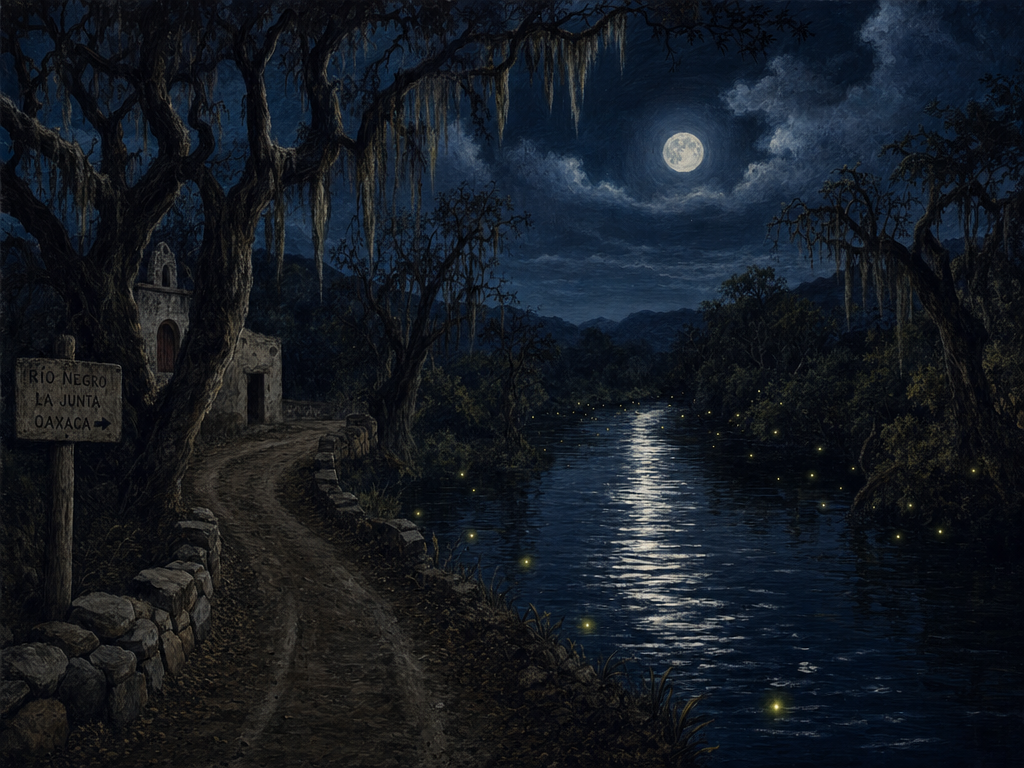
It was a woman's voice. She was certain of that. High-pitched and keening, the way grief sounds when it has been compressed for a long time and finally finds an exit — not sharp, not sudden, but sustained and rising and falling in a way that had no particular rhythm.
Mis hijos. Mis hijos. ¿Dónde están mis hijos?
My children. My children. Where are my children?
Elena went very still.
She knew this sound. Not from experience — she had grown up in Phoenix, had spent summers in Tucson and one long childhood visit to cousins in Sonora — but from something older than experience. From the version her grandmother had told her when she was seven years old, sitting on a concrete stoop in South Phoenix while the streetlights came on one by one down the block. From the way her grandmother had leaned in and dropped her voice when she got to the important part, the part you were supposed to remember:
If you hear her crying in the distance, do not go toward the sound.
Because she cries louder when she's far away. The closer she is, the quieter she sounds.
When she sounds far, she is near.
When she sounds near —
Her grandmother had paused here. Long enough that seven-year-old Elena had leaned forward on the stoop.
— you have a moment. You have just a moment. Use it.
The crying from downstream sounded distant.
It was the kind of distant that puts at least a kilometer between you and a sound — audible but thin, stretched across the night air the way sound carries over water. Half a kilometer, maybe. The way you hear a dog barking in another neighborhood, or a train on a track you can't see.
The legend says she sounds louder the further she is from you. 1 This sound was loud.
Elena stood by the car and did not move.
She had not grown up believing in much. She had not grown up with her grandmother's certainties intact. She was twenty-eight years old, had a degree in environmental policy, had hiked alone in three countries and camped in places with no cell signal for weeks at a time. She knew about grief. She knew how grief made sounds, how it echoed in ravines and carried over water.
She knew all of that.
She also did not move.
The crying went on for what felt like four or five minutes. It rose and fell, rose and fell. It moved, or seemed to move — first south, then back, then farther south again, traveling in a pattern that had no logic to it, the way something searching moves when it hasn't found what it's looking for. Her ghost is said to wander endlessly, searching for the children she lost. 2
Elena stood with her back against the front of the car, facing the bridge and the river, and she breathed slowly and watched the darkness over the water.
The crying was very distant. Very far.
She tried to remember the rest of what her grandmother had said, but there had been so many stories, and she'd been seven, and some parts of the memory had worn smooth with time like a stone in a river, the edges gone. She could remember the concrete stoop. She could remember the smell of her grandmother's hand lotion — something floral, something sweet. She could remember the tone. The particular seriousness of the tone, which had told her this story lived in a different category than the other stories, the ones with humor in them, the ones her grandmother told while cooking.
This story had been told in the voice of people who wanted you to actually listen.
She listened.
The crying stopped.
Between one breath and the next, it simply ceased — no fading, no taper, just gone. The insects continued. The frogs continued. The river made its low sound against the bridge piers. But the voice was gone, as though it had been cut off at the source.
Elena's hand found the car door handle behind her back. Not consciously — her body had been making that decision for some time.
From behind her, from the direction of the road she'd come from, she heard a single footstep on gravel.
Slow. Deliberate.
Then another.
She opened the car door and got in and pulled it shut and locked it in the same motion, and she was in the driver's seat with both hands on the steering wheel before she understood what she was doing. She turned the key. The engine caught and failed. She turned it again.
The footsteps on the gravel had stopped.
She turned the key a third time and held it, and the engine turned and turned and finally, with a deep reluctance, it caught. The dashboard lit up green and the hazard lights were still blinking their orange pulse and she put the car in drive and pulled out onto the bridge and crossed it without looking back.
She was two hundred meters past the bridge when she realized she'd been holding her breath.
She let it out. She let it all the way out.
In the rearview mirror there was only the road, empty and dark behind her, the bridge just barely visible as a pale gray line at the edge of the headlights' reach.
She reached down without looking and turned the radio on. Static on the norteño stations. She found something else — a voice, a distant late-night talk show, someone discussing something she couldn't follow — and she left it there, the sound of another human voice filling the car, and she drove.
She did not look in the side mirror.
Not because she was afraid of what she'd see.
Because she wasn't sure she wouldn't see something.
She reached San Marcos Tlapazola at 1:17 in the morning. The posada had left a key under a clay pot by the door, the way her confirmation email had said they would. Her room had one window overlooking a courtyard with a fig tree.
She sat on the edge of the bed for a while. She wasn't sure for how long.
Her phone had signal again. She called no one. She didn't have words for it — not yet, not at 1:17 in the morning with the trip still unfinished and the rest of the drive still ahead of her. She scrolled through her contacts for a while, her thumb stopping on her grandmother's name before she remembered that her grandmother had been dead for six years.
She set the phone face-down on the bedside table.
There were no sounds from outside except the normal sounds: wind in the fig tree, a dog somewhere distant, the deep country silence that isn't really silence at all.
She lay down with her shoes on.
She thought about her grandmother on that stoop in South Phoenix, leaning in, dropping her voice.
When she sounds near —
A pause.
— you have a moment. Just a moment. Use it.
She closed her eyes.
The crying she had heard had been distant. It had been very distant.
She told herself that was fine. She told herself that was the explanation: the grief of the geography, the way a ravine or a bend in a river can carry sound in ways you wouldn't expect, some woman downstream sobbing for reasons that had nothing to do with legend or her grandmother's stoop or the long-dead tradition of warning stories told in the dark. She told herself all of this, reasonably and clearly.
She didn't entirely believe it.
But she was alive, and she was horizontal, and in the morning there would be breakfast, and she had a mechanic's number from the posada host, and the road ahead was long and would be driven and would eventually end somewhere warm.
She reached over and turned off the light.
She left her shoes on.
La Llorona — "The Weeping Woman" — is one of the most enduring folk legends of Mexico and Latin America, with documented roots reaching back to at least the 16th century and possible connections to pre-Columbian beliefs. According to Encyclopaedia Britannica, the legend functions partly as a warning story: her cries are said to lure those who approach her, and one of its most eerie features is the acoustic inversion — the louder her crying sounds, the farther away she actually is. 1 The Library of Congress American Folklife Center has documented her legend across communities from Mexico into California and the wider Southwest. 2
"When the Crying Stops" is an original short story inspired by this tradition.
Add more perspectives or context around this content.